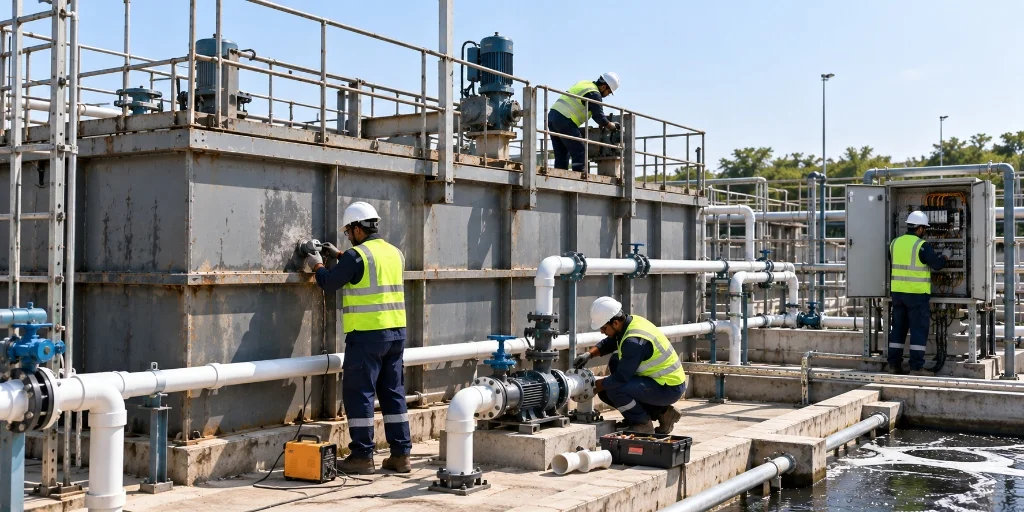
Every retrofit starts with an audit of your existing plant, not an assumption that a full rebuild is the only option. We identify whether the issue is capacity, occupancy or industrial load has outgrown the original design, technology, an older process struggling to meet current norms, or specific components, aging equipment, insufficient automation, causing the underperformance. Where possible, upgrades happen without full shutdown, keeping your plant operational through the transition rather than forcing an extended outage.
What We Cover in Plant Upgradation & Retrofitting
From targeted component fixes to full technology upgrades, scoped to what your plant actually needs.
Plant Audit & Diagnostic Assessment
A structured review of your existing plant identifies exactly what is causing underperformance before any retrofit gets proposed.
- Effluent testing and current performance benchmarking
- Equipment condition and capacity assessment
- Root cause identification for compliance or performance gaps
Capacity Expansion
Where growth in occupancy or industrial load has outpaced the original design, capacity gets added without necessarily rebuilding from scratch.
- Additional treatment stage integration (e.g. MBBR media into existing tanks)
- Parallel treatment train addition where space allows
- Hydraulic and process re-calculation for expanded capacity
Technology Upgradation
Replacing an aging or underperforming process with current technology, often within the existing tank structure.
- Conversion to MBBR, SBR or MBR technology within existing civil structure
- Automation and PLC/SCADA control upgrade
- Aeration and dosing system modernization
Component-Level Retrofits
Sometimes the fix is targeted, replacing specific failing components rather than the entire treatment train.
- Individual equipment replacement (blowers, clarifiers, filters)
- Tertiary treatment addition to an existing secondary system
- Sludge handling system upgrade
Minimal-Shutdown Execution
Retrofit work planned and sequenced to keep your plant operational through the transition wherever feasible.
- Phased retrofit scheduling to avoid extended downtime
- Temporary treatment arrangements where full shutdown is unavoidable
- Coordination around your site's operational constraints
Execution Process for Plant Upgradation & Retrofitting
A structured sequence from diagnosis to a plant performing the way it should.
Plant Audit
We test current effluent, assess equipment condition and benchmark performance against your discharge requirements, establishing exactly what is underperforming and why.
Retrofit Design
Based on the audit, a design gets prepared, adding new treatment units, retrofitting existing ones, or changing the process flow, scoped to what the audit actually revealed.
Technology Selection
Depending on required output quality and budget, suitable technology, MBBR, SBR, MBR or targeted component upgrades, gets selected against your specific constraints.
Execution & Minimal-Disruption Installation
New components get installed and integrated with existing infrastructure, sequenced to minimize shutdown wherever your site's operational needs allow.
Testing & Commissioning
The upgraded system gets tested to confirm it performs to the revised design specification before being signed off as complete.
Operator Training & Handover
Your operators get trained on the upgraded system, with standard operating procedures revised to reflect what has changed.
Key Benefits & Output Standards
A working plant again, without the cost and disruption of starting over.
Often Significantly Lower Cost Than a Full Rebuild
Existing Civil Structure Reused Wherever Sound
Minimal Shutdown Through Phased Execution
Regulatory Compliance Restored or Improved
Capacity Matched to Current, Not Original, Demand
Sectors Benefiting from Plant Upgradation & Retrofitting
Retrofit needs look different depending on what triggered the underperformance.
An aging Sewage Treatment Plant that was sized for lower occupancy years ago often needs capacity retrofit rather than full replacement as a society fills up.
Hotels and IT parks facing sludge or odour issues frequently resolve them through technology upgrade, adding tertiary treatment or converting to MBBR Based Sewage Treatment Plant or Compact MBR System technology within existing tanks.
An older Effluent Treatment Plant designed for looser discharge standards may need targeted upgrades to meet current CPCB and SPCB requirements without a full rebuild.
Public sewage infrastructure commonly needs phased rehabilitation and capacity augmentation as urban populations grow, often executed alongside ongoing O&M to avoid service interruption.
FAQs regarding Plant Upgradation & Retrofitting
Common questions about scope, cost and disruption.
Ready to find out what your existing plant actually needs?
Talk to our team about an audit and retrofit assessment for your current system.