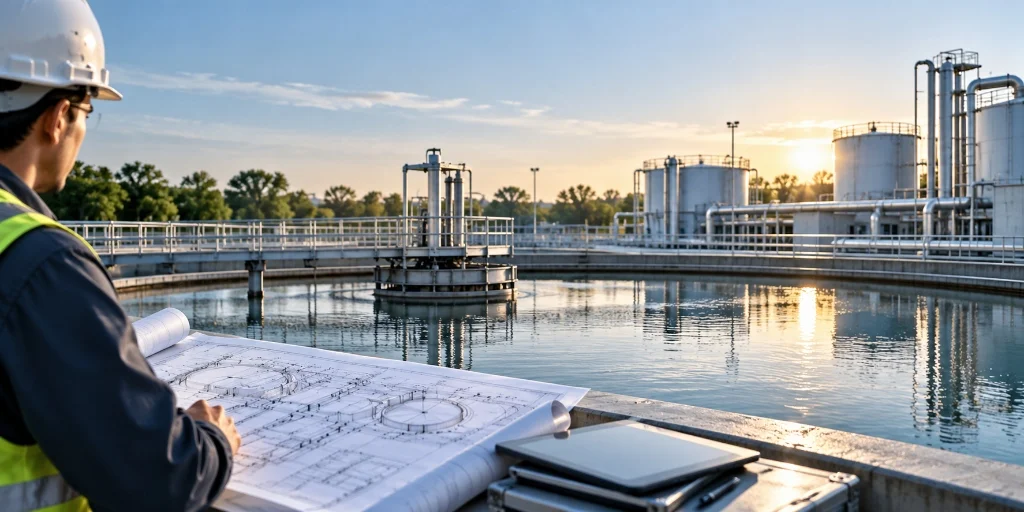
An effluent characterization study opens every project we take on, lab testing your actual wastewater rather than working from an assumed profile. That data feeds directly into process design sized for both your average daily flow and your peak load, since a plant that only performs well on an average day is not really designed, it is guessed at. Deliverables include process flow diagrams, P&IDs, hydraulic calculations and a detailed technical proposal your team can actually review before a single component gets fabricated.
What We Cover in Design & Engineering
End-to-end technical scope covering process design, equipment specification, civil integration and performance validation.
Process & Hydraulic Engineering
Custom mass balance and hydraulic calculations built on your actual effluent characterization, not a borrowed design.
- Mass balance and hydraulic profile calculations
- Process flow diagrams and P&ID development
- Civil layout and general arrangement drawings
Equipment Specification & Sourcing
Detailed specification of every reactor, clarifier, blower and membrane skid your plant needs, sized to your process design, not a generic catalogue entry.
- CPCB-compliant SS/FRP material specification
- Equipment datasheets and technical specifications
- PLC and control panel architecture
Commissioning-Ready Documentation
A complete technical package your fabrication and site teams can execute against without redesigning mid-project.
- Bill of quantities and technical specifications
- Single line diagrams and electrical load lists
- Conceptual design report for stakeholder sign-off
Regulatory & Consent Documentation
Technical documentation formatted for the SPCB consent and approvals your project actually needs before construction and operation can begin.
- Technical data packages for consent to establish applications
- Design basis reports for pollution board review
- Supporting documentation for consent to operate applications
Execution Process for Design & Engineering
A structured sequence that gets the design right before it reaches the workshop floor.
Sample Analysis & Characterization
We test your raw wastewater for COD, BOD, TSS, TDS and heavy metals, the baseline every subsequent design decision gets built on.
Process & Hydraulic Design
Mass balance calculations, hydraulic profile and process selection get worked out against your actual effluent data and site constraints.
Drawing & Documentation Package
Process flow diagrams, P&IDs, general arrangement drawings and equipment specifications come together into a package your team can review and approve.
Technical Proposal & Sign-Off
A detailed technical proposal consolidates the design for stakeholder review, ready to move into fabrication once approved.
Handover to Fabrication
Once approved, the finalized design package transfers directly to our in-house Fabrication & Manufacturing team, no gap between design intent and what actually gets built.
Key Benefits & Output Standards
Design work that holds up once the plant is actually running.
Sized for Peak, Not Just Average Load
CPCB & SPCB Norm Compliance Built In
Equipment Specified to Your Effluent, Not a Catalogue
Fewer Site Changes During Fabrication
Direct Handover Into In-House Fabrication
Documentation Ready for Regulatory Submission
Sectors Benefiting from Design & Engineering
Process design changes meaningfully depending on what your effluent actually contains.
High-color, high-COD wastewater needs color removal built into the process design from the start, not added as an afterthought once biological treatment underperforms. See our approach to Textile & Dyeing Effluent Treatment Plant design.
Refractory COD from API residues and solvents typically needs advanced oxidation worked into the process train early. See our approach to Pharmaceutical Effluent Treatment Plant and Chemical Industry Effluent Treatment Plant design.
High fat, oil and grease content needs dissolved air flotation or similar pre-treatment specified upfront, protecting the biological stages that follow. See our approach to Food & Beverage Effluent Treatment Plant design.
Hotels, hospitals and residential townships need compact, space-efficient designs matched to real occupancy patterns. See our approach to Sewage Treatment Plant design.
FAQs regarding Design & Engineering
Common technical and process questions answered by our engineering team.
Ready to discuss your Design & Engineering requirement?
Speak directly with our senior process engineers about your effluent characterization and site conditions.