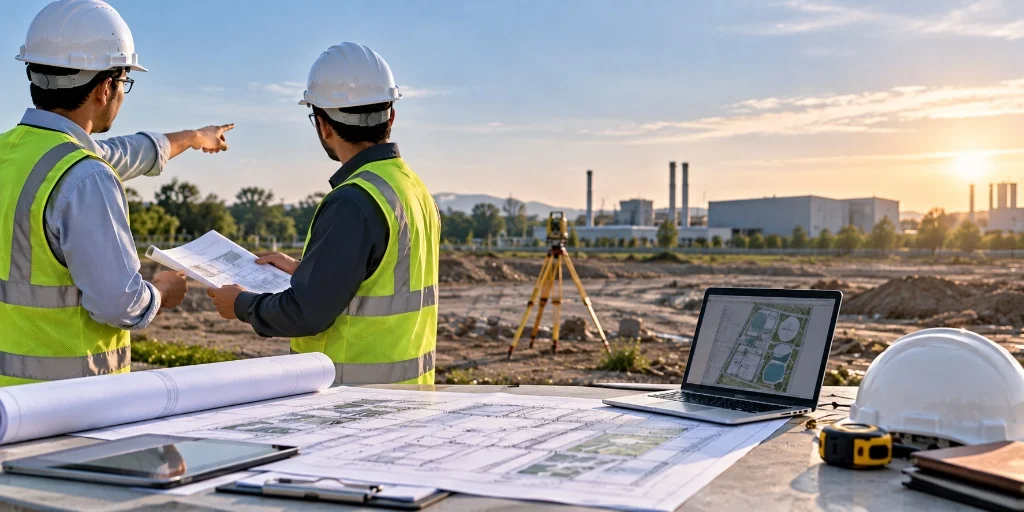
Every feasibility engagement starts with a site visit and an honest look at what your project is actually trying to solve, a new plant, a capacity upgrade, or a compliance gap that needs closing. We assess site suitability, applicable regulatory requirements, technology options and cost against expected outcome, then hand you a report you can actually take to a board, a bank, or a pollution control board without gaps in it.
What We Cover in Consultancy & Feasibility Study
A structured assessment covering technical viability, cost and regulatory fit before you commit to a design.
Site Suitability Assessment
On-ground evaluation of your site's constraints, plot size, access, existing infrastructure and utility availability, since a plan that looks fine on paper can fail on the ground.
- Plot layout and space constraint review
- Utility and power availability assessment
- Existing infrastructure compatibility check
Technology & Process Selection
Comparing viable treatment technologies against your effluent profile, budget and space, rather than defaulting to whatever is easiest to sell.
- Effluent characterization and load estimation
- Technology comparison against site and budget constraints
- Preliminary process selection recommendation
Regulatory & Compliance Review
Identifying which CPCB and SPCB norms actually apply to your project, and what approvals your timeline needs to account for.
- Applicable discharge norm identification
- Consent to establish requirement review
- ZLD or special mandate applicability check
Cost-Benefit & Investment Analysis
A realistic view of capital cost, operating cost and expected return, so the investment decision is based on numbers, not optimism.
- Preliminary capital cost estimation
- Operating cost projection by technology option
- Payback and lifecycle cost comparison
Execution Process for Consultancy & Feasibility Study
A structured sequence from first site visit to a decision-ready report.
Site Visit & Data Collection
We walk the site, review available utility and infrastructure data, and collect an effluent sample where relevant to the project scope.
Technical & Regulatory Assessment
Site constraints, technology options and applicable regulatory requirements get evaluated against your project's specific goals.
Cost & Viability Analysis
Capital cost, operating cost and expected outcome get compared across viable technology options, giving you a realistic cost-benefit picture.
Feasibility Report Delivery
Findings, recommendations and supporting data consolidate into a report suitable for internal approval, financing discussions or regulatory submission.
Recommendation Review
We walk through the report with your team, answering questions before you decide whether and how to proceed to design.
Key Benefits & Output Standards
Clarity before capital, not after.
Honest Technology Comparison, Not a Pre-Decided Pitch
Site-Specific Assessment, Not a Generic Template
Regulatory Requirements Identified Upfront
Realistic Cost Projections for Informed Decisions
Report Ready for Board, Bank or Regulatory Use
Sectors Benefiting from Consultancy & Feasibility Study
Feasibility questions look different depending on what stage and industry you are starting from.
Assessing whether existing infrastructure can support the color and COD load a Textile & Dyeing Effluent Treatment Plant actually needs, before committing to a design.
Evaluating ZLD applicability and advanced oxidation requirements early, where a Pharmaceutical Effluent Treatment Plant or Chemical Industry Effluent Treatment Plant may carry very different feasibility questions than standard industrial effluent.
Assessing whether a shared CETP model or individual plants make more financial sense for a cluster of smaller units.
Sizing feasibility for hotels, hospitals and townships planning a Sewage Treatment Plant as part of a larger construction project, where space and timeline constraints shape the right technology early.
FAQs regarding Consultancy & Feasibility Study
Common questions about scope, cost and next steps.
Ready to find out if your project is actually viable?
Speak directly with our engineers about your site, budget and timeline before committing to a design.