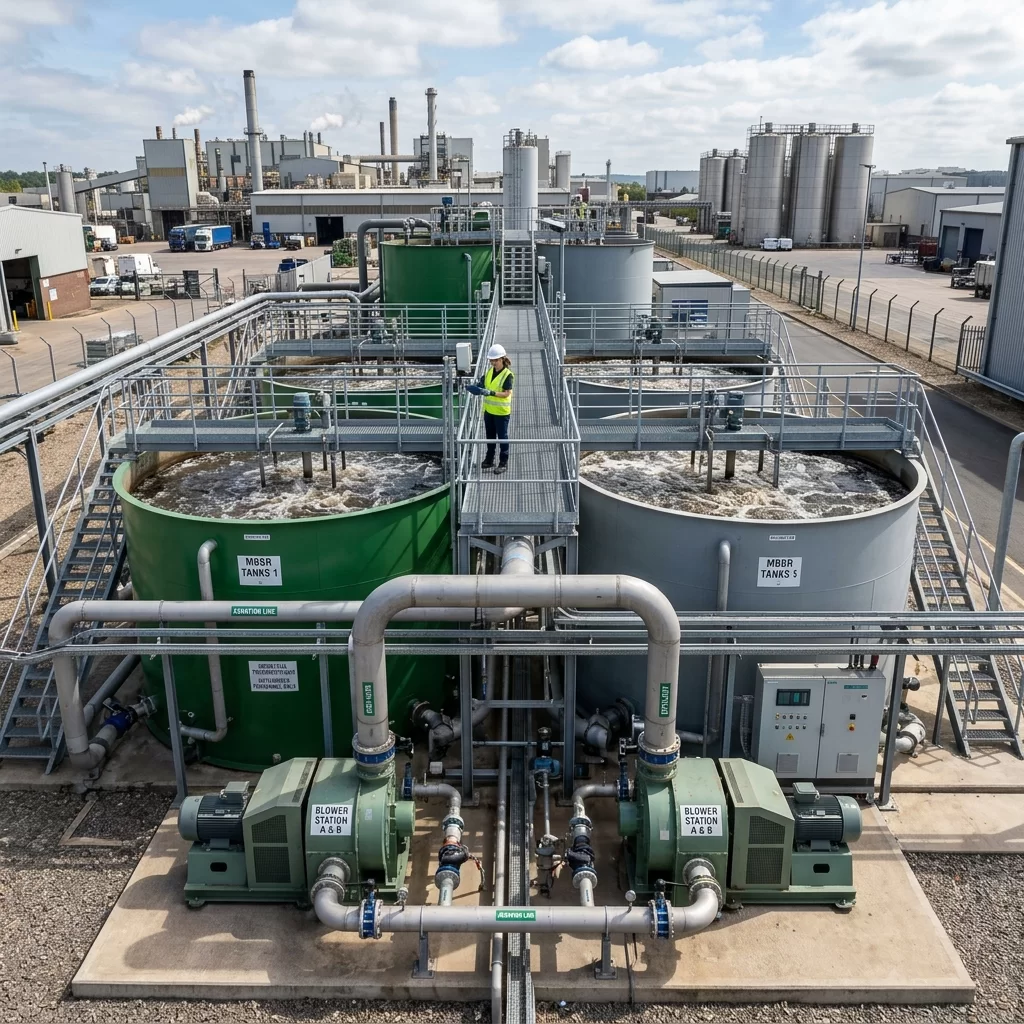
More Bacteria, Same Tank Size
A Moving Bed Biofilm Reactor works by suspending thousands of small polyethylene carriers, filling roughly a quarter to a third of the tank volume, in an aerated basin. Bacteria colonize the surface of these carriers, and because each carrier offers far more surface area than the same volume of open water, the tank supports a much denser bacterial population without needing to be any bigger. As an MBBR based sewage treatment plant manufacturer, this is the core advantage we build around, no primary clarifier is needed, sludge recirculation from a downstream clarifier is not required the way it is in conventional activated sludge systems, and detention time in the aeration tank runs considerably shorter than older designs, all while producing a fraction of the sludge conventional processes generate.
What Makes This Sewage Treatment Plant Worth the Investment
Smaller Footprint for the Same Capacity
Significantly Lower Sludge Output
Stable Under Load Variation
Lower Power Consumption
Retrofit-Friendly for Existing Plants
No Sludge Recirculation System Required
MBBR Systems Sized for Your Site
Media fill ratio, tank staging and automation level change with scale and whether this is a new build or a capacity upgrade to an existing plant.
Find the Right MBBR Configuration for Your Site
Compact MBBR System
A single-stage aeration tank with biofilm media, well suited to smaller residential buildings, standalone facilities or sites with tight plot constraints where footprint matters most.
Multi-Stage MBBR System
Staged aeration tanks for higher organic and nitrogen load, common for institutional campuses and commercial buildings needing consistent treatment performance under varying occupancy.
MBBR Retrofit for Existing STPs
Media added into your current activated sludge tank to increase treatment capacity without civil expansion, a practical option where occupancy has grown beyond your original plant's design capacity.
How This MBBR Sewage Treatment Plant Operates
Screening & Equalization
Incoming sewage is screened for coarse solids and buffered in an equalization tank so the biological stage receives a steady, manageable flow.
Aerated Biofilm Treatment
Wastewater enters the aeration tank, where diffusers keep thousands of biofilm carriers in constant motion while supplying the oxygen bacteria on the carrier surfaces need to break down organic matter.
Media Retention
A sieve or screen at the tank outlet keeps the biofilm carriers inside the reactor while treated water moves forward, so no media is lost downstream.
Settling & Clarification
Treated water passes to a settling stage where any remaining suspended solids separate out, producing minimal sludge compared to conventional systems since biomass stays attached to the carriers rather than floating freely.
Filtration & Disinfection
A final filtration and disinfection stage brings water to discharge-ready or reuse-ready quality.
Where This Fits Your Site
MBBR technology suits institutions, commercial buildings and residential developments where compact footprint and low sludge output matter as much as treatment reliability, hospitals, hotels, schools and office campuses are common applications. It also handles high-load industrial effluent well, and is frequently used as a retrofit solution for existing municipal or institutional plants that need more capacity without more space. If your current STP is struggling to keep up with growing occupancy and expanding the tank is not practical, an MBBR retrofit is often the more cost-effective path than building a new plant from scratch.
What Actually Drives the Cost of This System
Capacity and media volume are the main cost drivers, more carriers and larger aeration tanks for higher flow naturally cost more. Whether this is a new installation or a retrofit into an existing tank changes the cost picture significantly, a retrofit avoids the civil construction cost of a new tank, often making it the more economical route to added capacity. Automation level, basic aeration control versus full PLC/SCADA monitoring, adds to upfront cost but reduces ongoing operator attention needed. Lower sludge output and reduced power consumption compared to conventional systems typically offset some of the initial investment over the plant's operating life. We size cost around your actual flow, whether this is new or retrofit, and your reuse goals, not a flat per-KLD rate.
Frequently Asked Questions
In conventional activated sludge systems, bacteria float freely in the aeration tank and need a separate clarifier plus a sludge recirculation line to maintain bacterial concentration. MBBR bacteria live attached to carrier media, eliminating the need for sludge recirculation and requiring a smaller tank footprint for the same treatment capacity.
Yes, this is one of the more practical applications of the technology, MBBR media can be introduced into an existing activated sludge tank to boost treatment capacity without expanding the tank itself, useful where occupancy has outgrown the plant's original design.
Since biomass grows attached to the carrier media rather than as free-floating flocs, MBBR systems generate meaningfully less excess sludge than conventional activated sludge plants, reducing disposal frequency and the associated ongoing cost.
Yes, as an MBBR sewage treatment plant manufacturer, we build MBBR systems across residential, institutional and commercial applications, and specifically offer retrofit solutions where an existing plant needs more capacity without additional space.
No, MBBR generally needs less operator oversight than conventional activated sludge systems, since the process is more stable under load variation and does not require managing a separate sludge recirculation system.
Related Engineering Products
Need a Custom Wastewater Plant Recommendation?
Share your raw water laboratory reports and discharge limits with our senior engineering team.