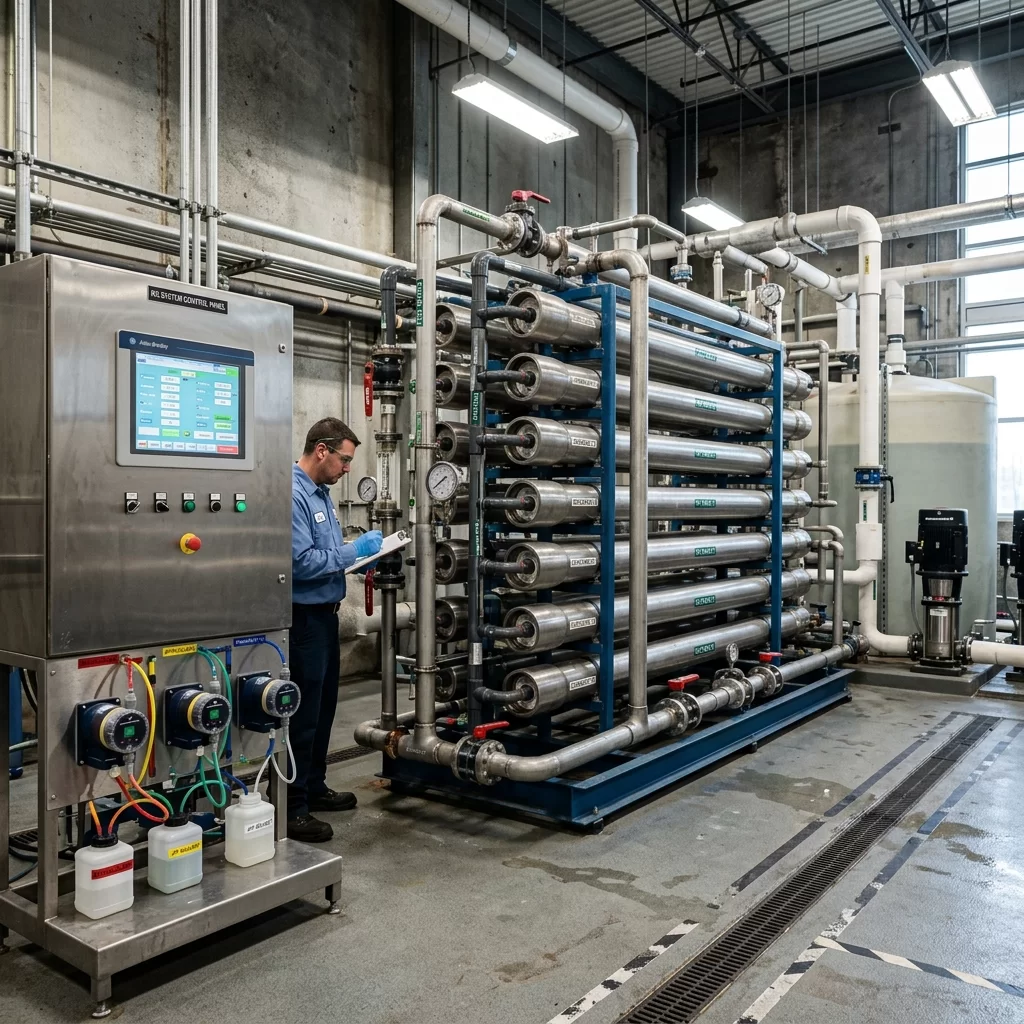
Pushing Water Where It Would Rather Not Go
Osmosis naturally moves water from a less concentrated solution toward a more concentrated one, across a semi-permeable membrane. Reverse osmosis works against that tendency, applying enough pressure, typically in a range determined by your feedwater's salt concentration, to force water molecules through the membrane while dissolved salts, ions, colloidal matter and organic compounds get left behind on the reject side. What passes through, the permeate, comes out as high-purity water suitable for boiler feed, process use, or discharge-ready reuse. What does not pass through concentrates into a reject stream that needs its own handling. Our water recycling plant designs account for both sides of that split, since a system that only thinks about permeate quality and ignores reject volume and disposal ends up creating a second problem while solving the first.
What Makes This System Worth the Investment
High-Purity Output for Critical Applications
Pre-Treatment Sized to Protect Membranes
Built-In CIP for Membrane Longevity
Real-Time Performance Monitoring
Water Recovery That Cuts Freshwater Cost
Scales From Small Commercial to Large Industrial
Types of RO and Water Recycling Systems We Manufacture
Feedwater source, purity requirement and end use all shape which configuration fits your site. We do not sell one membrane stack and call it universal.
Find the Right RO or Recycling Configuration for Your Site
Industrial RO Plant
Built for continuous, high-volume operation on variable feedwater quality, commonly used for process water, boiler feed and wastewater recovery in manufacturing environments. See full specifications for Industrial RO Plant.
Commercial RO Plant
Sized for offices, hotels, hospitals and smaller commercial establishments needing consistent purified water for drinking or utility use rather than heavy industrial process demand. Explore our Commercial RO Plant.
Wastewater Recycling System
RO configured specifically to treat wastewater for reuse rather than fresh feedwater, recovering treated effluent for cooling towers, flushing or process water and cutting freshwater intake. View our Wastewater Recycling System.
DM Plant / Water Softener
Demineralization for applications needing extremely pure water, boiler feed and certain manufacturing processes, often paired with RO as a polishing step, alongside softening for hardness removal ahead of the RO stage. See our DM Plant and Water Softener specifications.
Tertiary Treatment Plant
The final polishing stage after primary and secondary treatment, using RO or UF filtration to bring treated water to a quality suitable for reuse rather than just compliant discharge. See our Tertiary Treatment Plant.
RO and Recycling Process, Stage by Stage
Pre-Treatment
Dual media filtration removes suspended solids and turbidity, while antiscalant dosing prevents mineral scaling on the membrane surface before water ever reaches the RO stage.
Reverse Osmosis Filtration
High-pressure pumps force pre-treated water through semi-permeable membranes, separating it into high-purity permeate and a concentrated reject stream.
Permeate Collection
Purified water is collected as the usable output, routed to storage or directly into your process, boiler feed or reuse application.
Reject Stream Handling
Concentrated reject water is managed per your site's requirements, sometimes recovered further through additional treatment, sometimes discharged per compliance norms depending on your setup.
Monitoring & Membrane Care
Continuous monitoring through pressure, flow and conductivity sensors tracks system performance, with periodic CIP cleaning maintaining membrane efficiency over the system's operating life.
Which System Fits Your Facility
Manufacturing and process-heavy facilities generally need industrial RO for boiler feed and process water, where consistent high-volume output matters more than compact footprint. Offices, hotels and hospitals typically suit commercial RO, sized for utility and drinking water rather than industrial throughput. Where the goal is recovering treated wastewater rather than purifying fresh feedwater, a dedicated recycling system, often paired with tertiary treatment, is the right starting point rather than a standard RO plant. Facilities needing extremely pure water for boiler feed or specific manufacturing processes typically add a DM plant downstream of RO rather than relying on RO purity alone.
What Actually Drives the Cost of This System
Feedwater quality is the single biggest cost driver, high-TDS or heavily contaminated feedwater needs more extensive pre-treatment and higher-pressure operation than relatively clean source water. Capacity moves cost proportionally, but not perfectly linearly, larger systems benefit from some economy of scale in membrane and pump sizing. Recovery rate matters too, pushing for a higher percentage of feedwater recovered as usable permeate typically requires additional stages or higher pressure operation, adding cost but reducing ongoing freshwater expense. We size cost around your actual feedwater analysis and recovery target after an initial assessment, not a flat per-liter rate that ignores what your water source actually requires.
Frequently Asked Questions
Industrial RO plants are built for continuous, high-volume operation on variable feedwater quality, typically for process water, boiler feed or wastewater recovery. Commercial RO plants are smaller scale, generally for drinking or utility water in offices, hotels or smaller establishments where volume demand is lower and consistency matters more than industrial throughput.
Well-optimized recycling systems commonly recover 90 to 95 percent of treated wastewater for reuse, though the exact figure depends on source water quality, TDS levels and system design, which we assess specifically during your site evaluation.
If your application needs extremely pure water, boiler feed or certain manufacturing processes, DM treatment as a polishing step downstream of RO is often necessary since RO alone may not achieve the required purity level.
Reject water concentrates the dissolved salts and contaminants removed from the feedwater, it can sometimes be recovered further through additional treatment, or requires compliant discharge or disposal depending on your site's specific setup and regulations.
Yes, as an RO plant manufacturer, every RO system comes with an AMC option covering scheduled maintenance, membrane cleaning and replacement guidance, and spare parts support, since membrane performance directly determines whether your system keeps delivering the water quality it was designed for.
Related Engineering Products
Need a Custom Wastewater Plant Recommendation?
Share your raw water laboratory reports and discharge limits with our senior engineering team.